
The Utility That Sells the Fuel
Cameco is not a uranium bet. It is a toll on the entire Western nuclear fuel cycle, and the market is finally paying for it.

Cameco Corporation · NYSE: CCJ / TSX: CCO · Rating: Hold
Disclosure: I own Cameco and am not adding here. Research and opinion, not investment advice.
The Thesis
Most people look at Cameco and see a uranium miner, so they price it like a commodity producer and get scared off by the multiple. I think that framing is wrong, and the mispricing lives inside it. Cameco is closer to a regulated toll operator on the Western nuclear fuel cycle than it is to a spot-price miner. It owns the world's largest high-grade uranium mine, the world's largest uranium mill, and a 49% stake in Westinghouse, the company whose reactor technology a huge share of the Western fleet is built on and depends on for parts, servicing, and fuel fabrication.
Here is the crude sum-of-the-parts that reframes the multiple. Cameco paid US$2.1 billion for its 49% of Westinghouse in late 2023; on the guided 2026 EBITDA share of ~US$365 million midpoint, growing 6 to 10% a year, that stake is plausibly worth two to three times what was paid today. Back even a conservative mark on Westinghouse out of the ~US$38.6 billion market cap, and the contracted mining business is left carrying most of the valuation on its own, which is precisely the part that is not a spot-price bet. The market is quoting one number for two very different businesses.
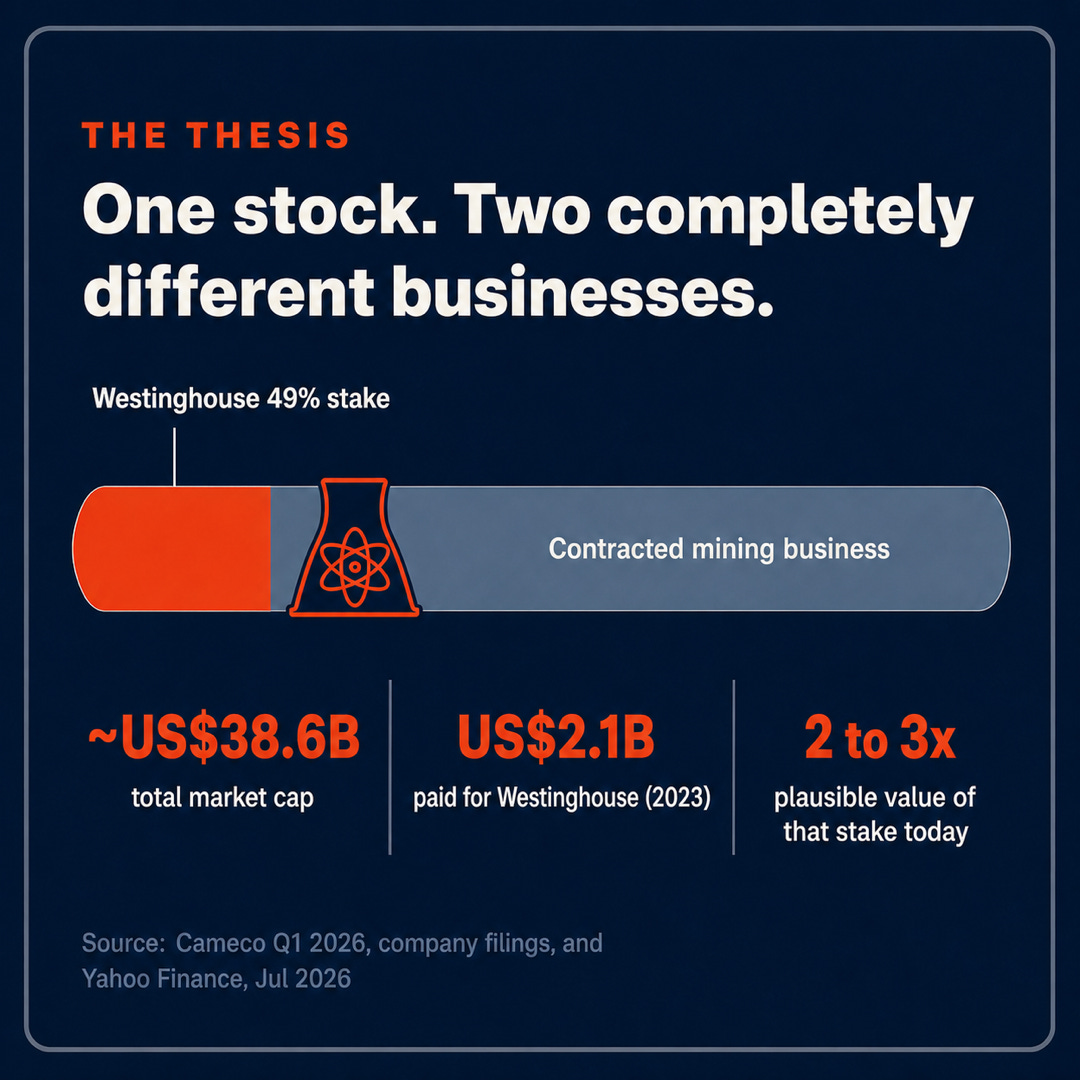
It sells most of its uranium years in advance under long-term contracts, not into the spot market. So the real question is not "where does uranium trade next month." It is "who does a US or European utility trust to deliver enriched, fabricated fuel for the next 20 years without touching Russian or Kazakh supply chains that keep breaking." There are very few credible answers, and Cameco is at the front of the line. That is why I own it, and why I think the demanding multiple is measuring the wrong thing.
The Mechanism
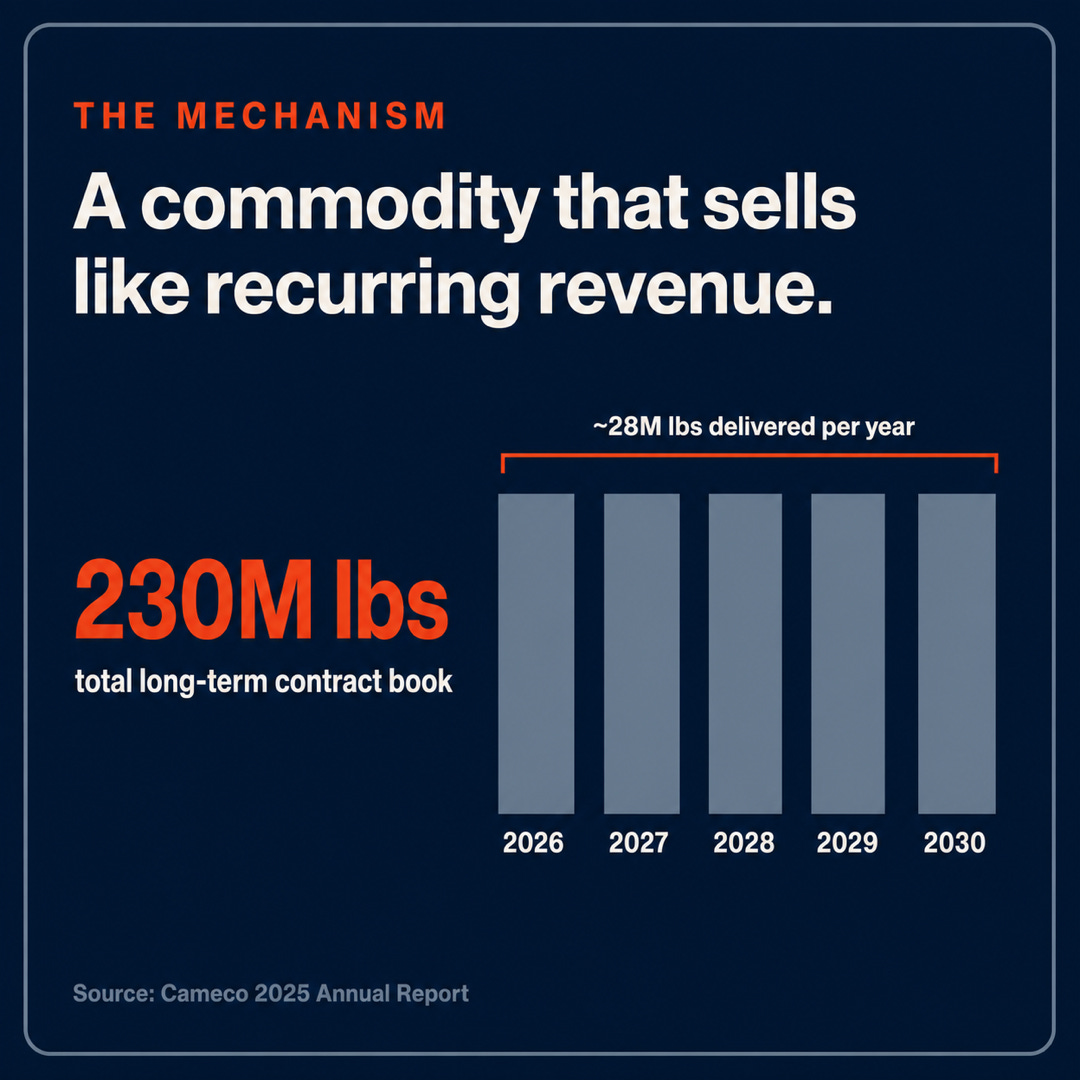
Start with the mine. McArthur River and Key Lake are tier-one assets, and Cameco is the majority owner. In 2025 the company produced its share of a high-grade base that most competitors cannot match on cost. But the part that matters for the thesis is how it sells. Cameco carries a long-term contract book of roughly 230 million pounds of uranium, with commitments to deliver about 28 million pounds a year over the next five years. That book is the whole point. It converts a violently cyclical commodity into something that looks a lot more like contracted, recurring revenue.
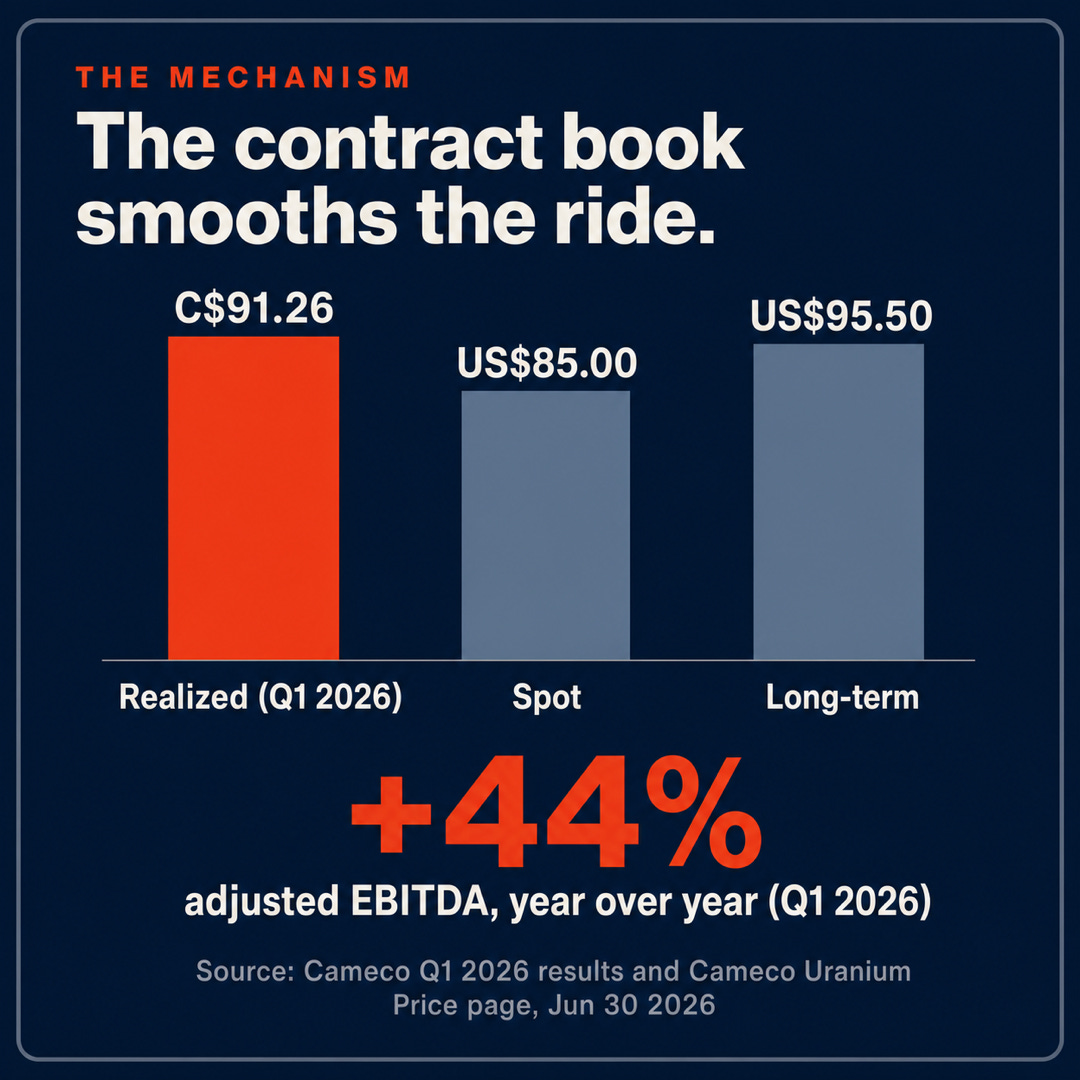
When spot uranium spiked toward US$100 a pound earlier in 2026 and then settled back to US$85 spot and US$95.50 long-term at the end of June, Cameco's realized price did not whip around with it, because the book smooths the ride. In Q1 2026 the company reported C$845 million of revenue, C$509 million of adjusted EBITDA up 44% year over year, and an average realized uranium price of C$91.26 a pound. That is a producer earning a premium to spot because it locked in price and volume when others could not.
Then there is Westinghouse, and this is the piece the market still underrates. In late 2023 Cameco and Brookfield bought Westinghouse at an enterprise value near US$8 billion. Cameco put in US$2.1 billion for its 49%. Westinghouse is not a mine. It is the installed-base servicing and fuel-fabrication business for a global reactor fleet, which means it earns high-margin, sticky, multi-decade revenue tied to reactors that are not going anywhere. In Q1 2026 Cameco's 49% share of Westinghouse adjusted EBITDA was C$122 million, up from C$92 million a year earlier, and the company guided its full-year 2026 share to US$335 million to US$395 million with a 6% to 10% annual growth outlook. So Cameco now has two engines: a contracted mining business and an equity stake in the razor-blade business of the entire Western nuclear industry. That combination is why I think "miner" is the wrong label.
The balance sheet lets it play offense. At the end of Q1 2026 Cameco held roughly C$1.11 billion in cash against about C$1.0 billion of debt, a net-cash position. Westinghouse's own debt sits off Cameco's balance sheet under the equity method. A commodity company that is net cash at the top of its own cycle is a company that does not have to sell into weakness.
The Risk
Here is where I have to be honest, because I own it and the easiest way to lose money is to fall in love with your own position.
The valuation is rich. At $88.68 a share, Cameco carries a market cap of $38.62B, a trailing P/E of 70.4 on TTM EPS of $1.26, and a 2025 EV/EBITDA of 59.8x on EV/Sales of 15.7x. Those are not miner multiples. They are priced for the uranium-deficit thesis and the Westinghouse growth story to both keep compounding. Here is the math that keeps me in it anyway: on a full run-rate where the ~28 Mlbs/yr book realizes a mid-C$90s price and Westinghouse's ~US$365 million EBITDA share compounds at high-single digits, the blended forward earnings power looks far cheaper than the 70x trailing headline. That trailing multiple is distorted by earnings still ramping into the contract book and the Westinghouse consolidation. If either engine stalls, though, there is a lot of air under the stock. The 52-week range tells you how violent that can be: the stock has traded from $68.96 to $135.24 inside a single year. This is not a quiet compounder. You have to be able to stomach that.
The operations are genuinely hard. Cigar Lake has had multiple water inflows over its life, needs ground freezing to mine, and depends on Orano's McClean Lake mill, which had a roughly two-week sulfuric-acid-plant disruption in July 2026 (since resolved, with no change to 2026 guidance). McArthur River faces its own development and freeze-timing risk, plus a planned extended Key Lake mill shutdown in 2026. Any of these can dent a quarter.
The cycle is real. Uranium spent years in a brutal bear market after Fukushima, and Cameco's own history shows it: the company posted negative or erratic earnings through much of 2016 to 2021 before the recovery. Buying a cyclical at a high multiple near strong sentiment is exactly how people get hurt.
And the geopolitics cut both ways. Kazakhstan's Kazatomprom is the largest and lowest-cost producer at around 40% of world output, versus Cameco near 15%. The same Western supply-chain anxiety that helps Cameco also means the market leans on Russia for a large share of conversion and enrichment, with US import waivers expiring at the start of 2028. If that transition goes smoothly, some of Cameco's scarcity premium fades. If it does not, Cameco's own Kazakh joint venture, Inkai, has already shown it is exposed to the same transport and supply disruptions.
So the bear case is simple: a cyclical commodity producer priced like a compounder, with real operational fragility, at a point in the cycle when sentiment is strong. That is not nothing. I hold it anyway because I think the contract book plus Westinghouse changes the quality of the earnings enough to justify paying up, but I am not pretending the risk is small.
The Read
My view is that Cameco is a structurally advantaged business trading at a price that demands patience. The thing I keep coming back to is that the market is still arguing about uranium spot prices while the more durable story is that Cameco has quietly become a two-sided toll on Western nuclear: contracted fuel on one side, the servicing and fabrication monopoly-ish asset on the other. Those are not commodity earnings. They are closer to infrastructure earnings, and infrastructure earnings deserve a higher multiple than a miner.
I own it, and I am not adding here. The multiple only works if the deficit thesis and Westinghouse both deliver, and after a year that ran from the sixties to the one-thirties, I would rather let a weak quarter or an operational stumble hand me a better entry than chase it at the top of the range. What I am watching: the Q1 realized-price trend continuing to run ahead of spot, the Westinghouse EBITDA share landing inside that US$335 million to US$395 million guide, the 2028 Russian-supply transition, and any crack in the contract book. If the realized-price premium holds and Westinghouse compounds, the "expensive" multiple ages into a fair one. If uranium sentiment breaks first, this trades like the cyclical it used to be. I think the first path is more likely, which is why I am a holder. I just refuse to call it cheap.
Sources
Q1 2026 revenue, adjusted EBITDA, realized price, Westinghouse share & guidance (Cameco, Q1 2026)
Contract book ~230 Mlbs, ~28 Mlbs/yr commitments, net-cash position (Cameco, 2025 Annual Report)
Uranium spot US$85/lb, long-term US$95.50/lb (Jun 30, 2026) (Cameco Uranium Price)
Westinghouse 49% stake, US$2.1B equity, closed Nov 2023 (Cameco / Brookfield)
Westinghouse 2026 EBITDA-share guidance US$335 to 395M, 6 to 10% growth (Cameco, Q1 2026 MD&A)
Operational risk, Kazatomprom ~40% share, Russian reliance, 2028 waiver expiry (Cameco 2025 AIF)
July 2026 Cigar Lake / McClean Lake disruption resolved, no guidance change (Yahoo Finance, Jul 15)
Global uranium demand +28% by 2030, more than double by 2040 (WNA 2025 Fuel Report)
Live price, market cap, P/E, EPS, 52-week range, EV/EBITDA, EV/Sales (Yahoo Finance — CCJ)
About SecondPitch
SecondPitch is an independent equity research letter. Each issue takes one idea from the market, a podcast, a filing, or a company, and explains the mechanism behind it, in the register of a buy-side analyst. Coverage centers on market structure, credit and fixed income, real assets, and quality-value investing.
© 2026 SecondPitch™. Written by Justin Alexandrowicz. Reach me at justin@secondpitch.ca or connect on LinkedIn.