
The Hidden Financier
Everyone thinks banks and venture capital are paying for the AI buildout. The real balance sheet is an insurance company.

The Mechanism
Ask who is financing the AI boom and most people say Silicon Valley, the hyperscalers, or the big banks. The more accurate answer is an insurance company.
Here is the mechanism. When you buy an annuity, you hand an insurer a large sum today in exchange for payments that stretch out over decades. That money does not sit idle. The insurer invests it, keeps the spread between what it earns and what it owes you, and because the liabilities are long and predictable, the capital behind them is effectively permanent. It cannot be redeemed on a bad Tuesday. That is the quiet superpower of an insurance balance sheet: patient money that does not run.
Apollo has said the quiet part out loud. Its stated edge is permanent capital from its insurance ecosystem, anchored by the annuity insurer Athene. Apollo originated roughly 309 billion dollars of loans through 2025 and has said it believes it can originate up to 100 billion a quarter, feeding that permanent capital into data centers, chips, and power infrastructure that traditional banks alone cannot fund.
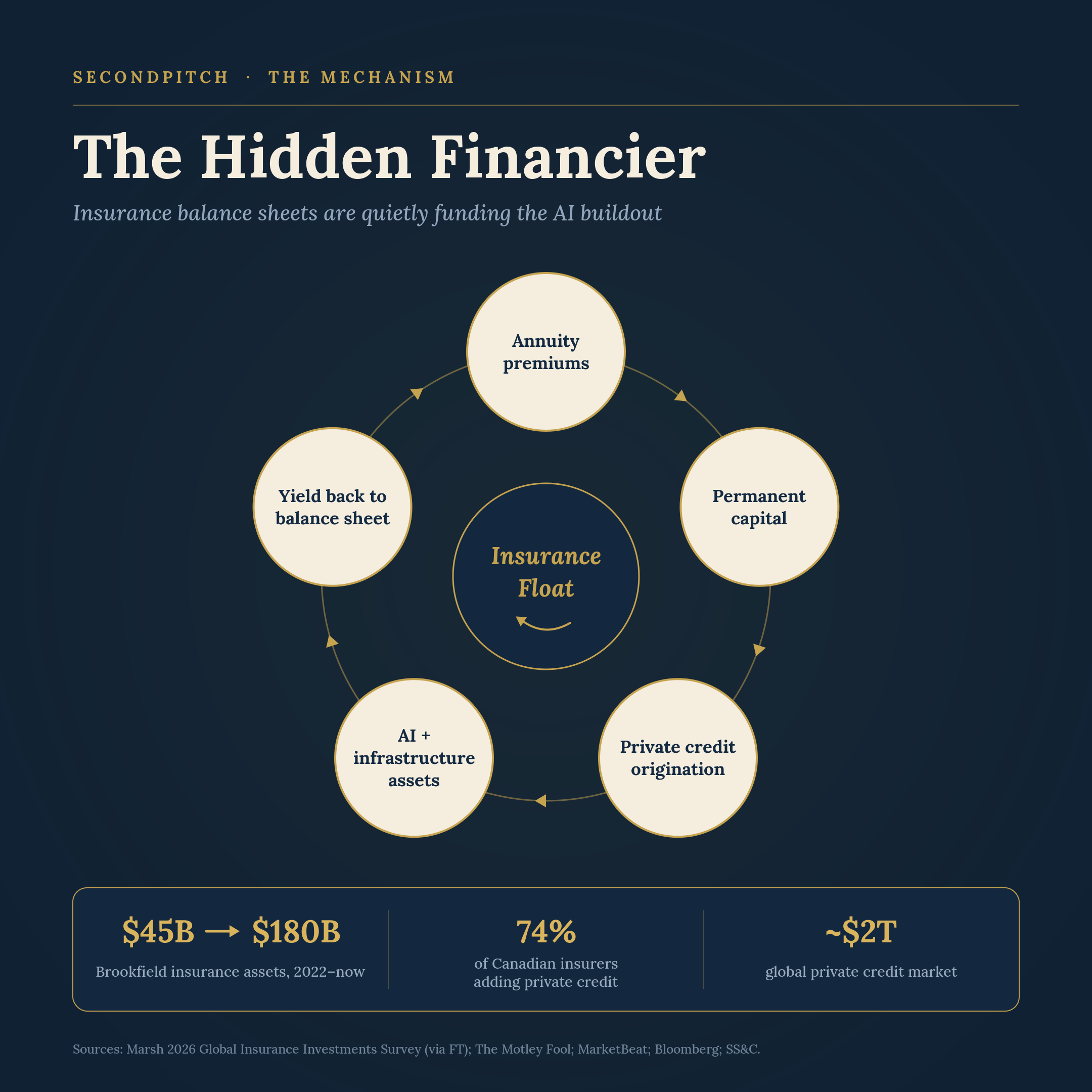
This is not one firm’s trick. It is the new architecture of credit. The flywheel looks like this:
Annuity premiums come in
They become permanent capital
That capital originates private credit
The credit funds long-lived assets like AI infrastructure
The yield flows back onto the insurance balance sheet, supporting the next round of policies
Round and round.
Brookfield, the firm I follow most closely, has built the same machine. Its insurance assets grew from 45 billion in 2022 to over 180 billion by the end of last year, and its total capital in that arm went from 5.7 billion to 19.8 billion over the same window. Management now describes a permanent capital base of roughly 175 billion, one of the largest pools of discretionary capital globally, with 188 billion deployable.
The appetite is broad, not niche. In Marsh’s 2026 Global Insurance Investments Survey, 57 percent of insurers globally plan to increase private credit exposure over the next 12 to 24 months, ahead of public investment-grade fixed income at 48 percent. In Canada the figure is 74 percent, the highest of any region. The global private credit market now sits near 2 trillion dollars, and insurers’ private credit holdings have more than tripled in a decade.
So the picture is coherent. The most durable pool of capital in the system has found the most capital-hungry buildout in a generation, and the firms that own the annuity engine are the ones writing the cheques.
The Screen
Two things worth watching if this mechanism is real.
First, the risk the insurers themselves name. In the same Marsh survey, insurers named three top concerns:
Shrinking illiquidity premium and tighter spreads: 66%
Weaker underwriting and covenants: 54%
Rising defaults or payment-in-kind structures: 51%
Translation: the people deploying the capital know the reward for illiquidity is thinning even as they deploy more of it.
Second, the regulators are moving. The NAIC voted in early July to pull private credit CLOs into a new risk-based capital regime, and Europe’s EIOPA published a factsheet showing EEA insurers hold about 1.185 trillion euros in private assets, roughly 11 percent of total assets. When capital charges change, the flywheel’s economics change with them. That is the variable I would model first.
The Read
If you want the primary version of this story, start with the Marsh 2026 Global Insurance Investments Survey for the allocation data, then read Brookfield’s own permanent-capital framing from its recent shareholder communications. The Bloomberg reporting on Apollo and Athene is the clearest statement of the thesis from the inside.
One line to take away: in this cycle the scarcest thing is not a good asset, it is patient capital, and the insurers quietly own it.
Sources
Marsh 2026 Global Insurance Investments Survey (via FT)
Brookfield insurance assets 45B→180B (The Motley Fool, Jul 14)
Brookfield 175B permanent capital base (MarketBeat, Jul 16)
Apollo / Athene ~309B originated (Bloomberg, Jul 2026)
~2T private credit market (SS&C, Jul 14)
EIOPA €1.185T private assets (EIOPA, Jul 16)
About SecondPitch
SecondPitch is an independent equity research letter. Each issue takes one idea from the market, a podcast, a filing, or a company, and explains the mechanism behind it, in the register of a buy-side analyst. Coverage centers on market structure, credit and fixed income, real assets, and quality-value investing.
Written by Justin Alexandrowicz. Reach me at justin@secondpitch.ca or connect on LinkedIn.