
Buy the Owner, Not the Manager
Everyone owns BAM for the fee stream. The mispriced one is BN, the parent that owns it, at a discount to its own assets.

Brookfield Corporation · NYSE: BN / TSX: BN · Rating: Buy
Disclosure: I own Brookfield Corporation. Research and opinion, not investment advice.
The Thesis
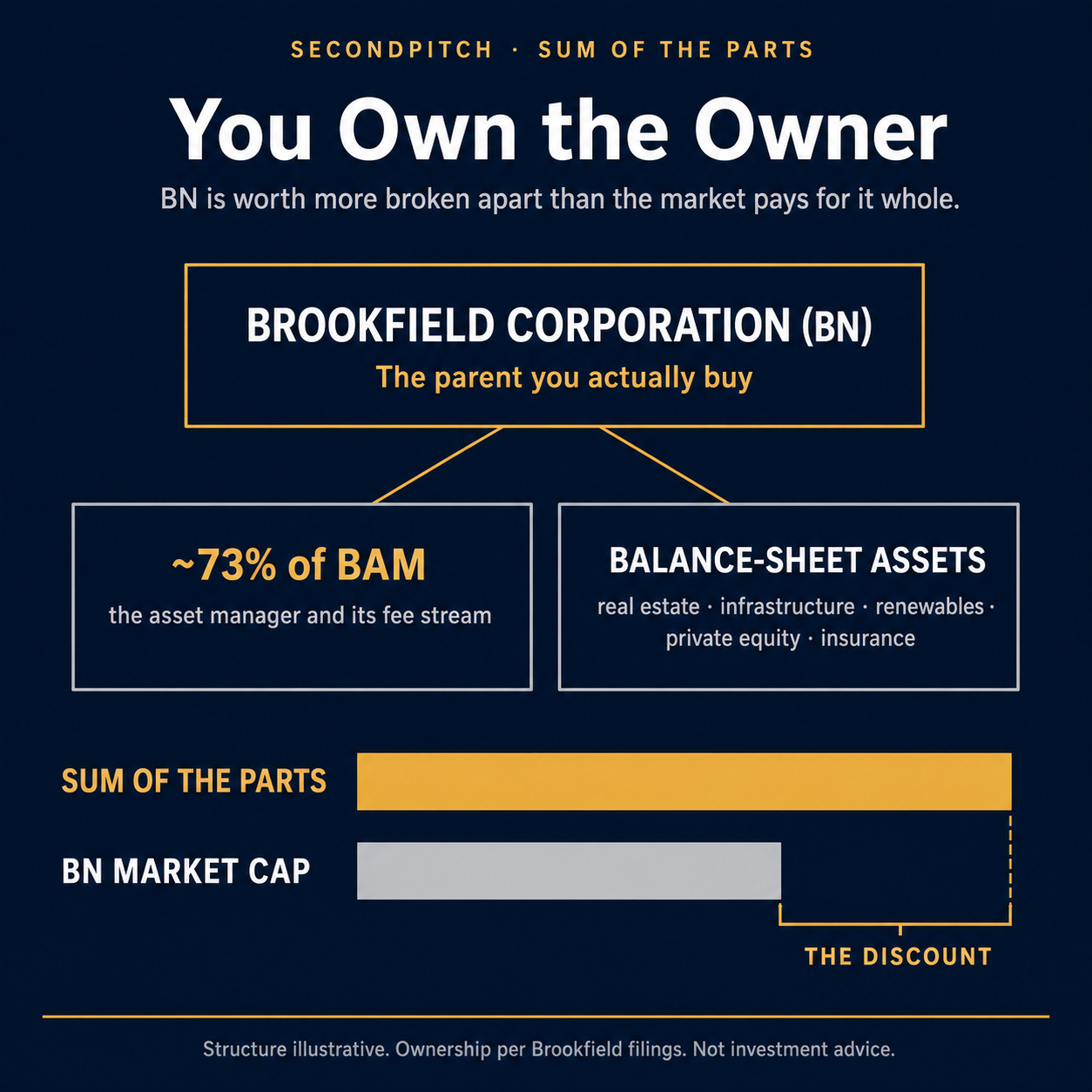
Most people who own Brookfield own the wrong ticker. They buy BAM, the asset manager, because it is the clean story: capital-light, collects fees, raises the dividend. That is a good business. It is not the mispriced one.
The mispriced one is BN, the parent. BN owns roughly 73 percent of BAM outright, and on top of that stake it holds a balance sheet full of real assets: real estate, infrastructure, renewables, private equity, and a fast-growing insurance operation. Add the market value of the BAM stake to the marked value of everything BN owns directly, subtract the debt, and the total comes out meaningfully higher than what BN trades for. That gap is the entire idea. On Brookfield’s own math the parts are worth roughly 66 dollars per share, and management has been buying back stock in the low forties at what it calls an approximate 40 percent discount to intrinsic value. You are buying a dollar of assets for less than a dollar.
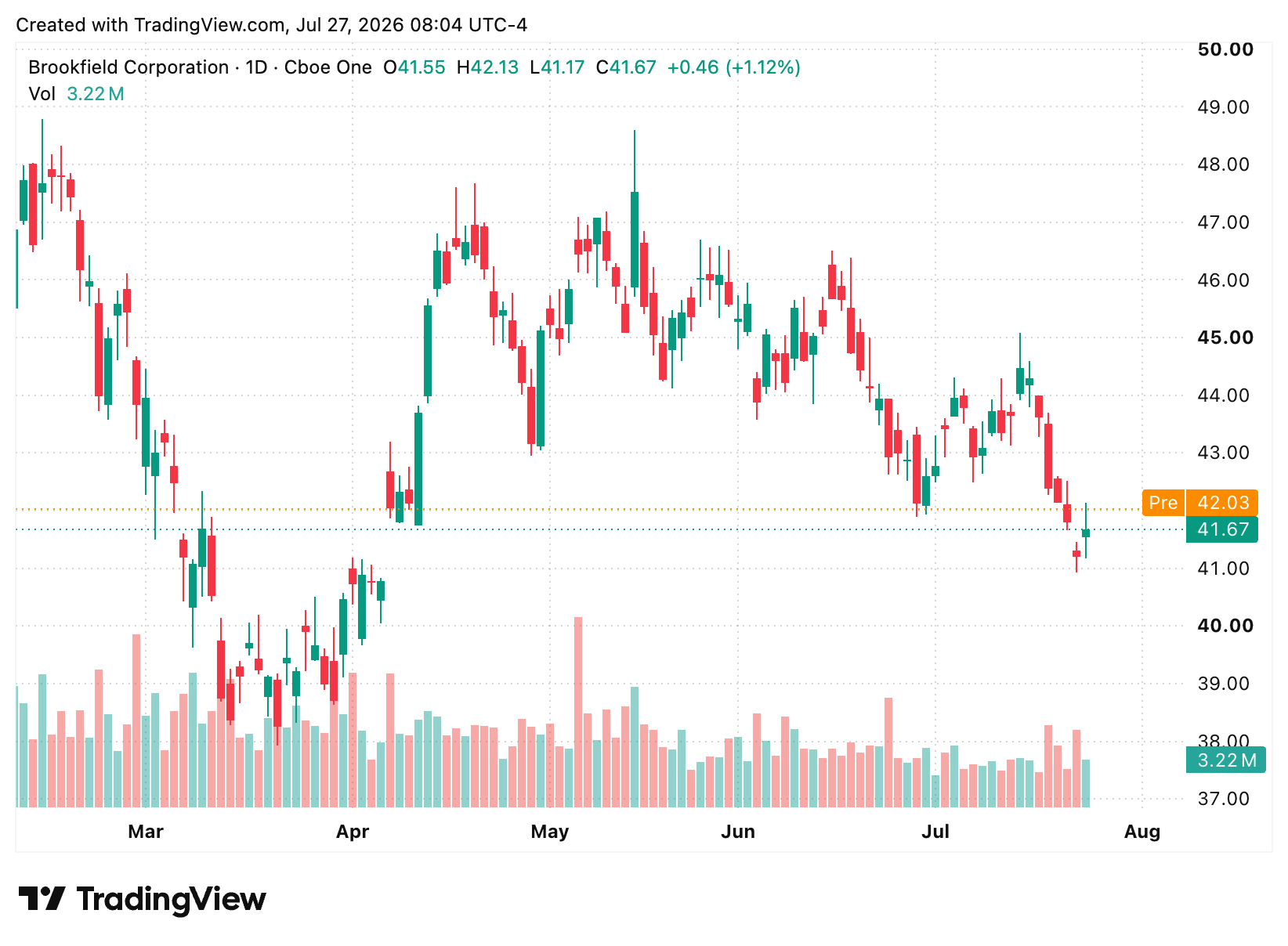
BN trades in the low forties with a market cap near 93 billion. It is not sitting at its highs; it is closer to the bottom of its 52-week range. The trailing multiple looks steep, but that is a distortion, not a valuation. BN’s IFRS earnings are lumpy and dominated by non-cash marks, which is exactly the noise the sum-of-the-parts is built to see through. Strip it out and the picture is simple. This is not a case of paying up for quality and hoping it works out. It is a discount to a set of parts that are themselves compounding.
The discount is not my edge. Everyone can see the discount. My edge is why it closes, and that lives in the insurance arm.
The Mechanism
Start with the structure, because the structure is the whole reason the discount exists. BN is a holding company. Holding companies almost always trade below the sum of what they own, because the market applies a conglomerate discount: investors do not want to underwrite five businesses at once, so they pay less for the bundle than for the pieces. Fair enough. The question is what makes this particular discount narrow rather than sit there forever.
The answer is Brookfield Wealth Solutions, the insurance engine, and this is the part most people underrate.
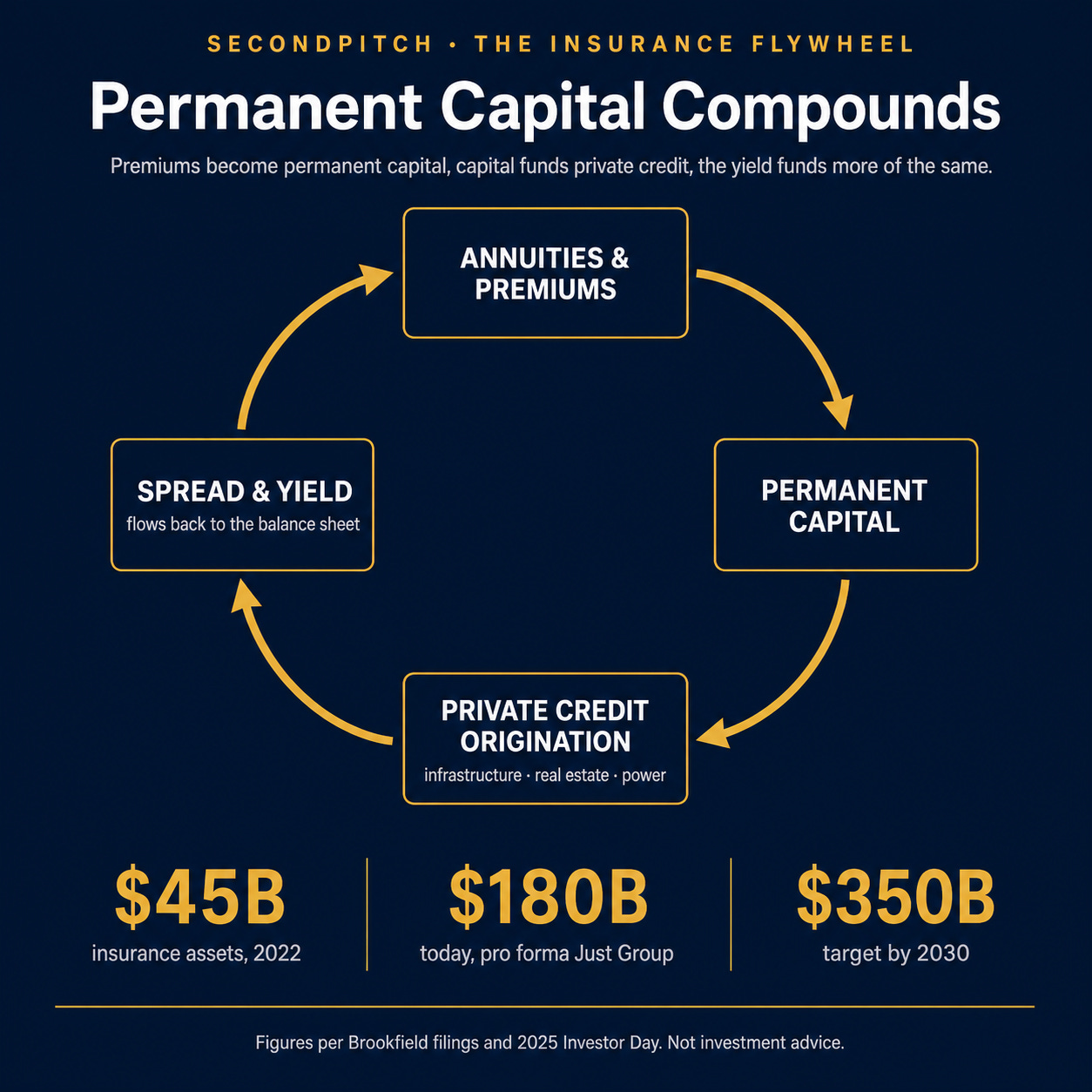
Here is how the flywheel turns. Brookfield sells annuities and writes insurance. The premiums it collects are effectively permanent capital, money it holds for years or decades before it has to pay out. Brookfield takes that permanent capital and originates private credit into exactly the long-lived assets it already knows how to underwrite: infrastructure, real estate, power. It earns a spread between what it makes on those assets and what it owes policyholders, and that yield flows back onto the balance sheet, which funds more origination. The base compounds.
The numbers are not small, and they are the reason I think the discount cannot hold. Brookfield reported about 144 billion of insurance assets on its March 31, 2026 balance sheet, and pro forma the close of the Just Group acquisition that figure rises to over 180 billion, up from roughly 45 billion in 2022 (source: Brookfield Q1 2026 Supplemental). The capital underneath it grew from 5.7 billion in 2022 to 19.8 billion at the end of 2025 (source: Brookfield Wealth Solutions). Management has laid out a path to 350 billion of insurance assets by 2030 (source: BN Investor Day 2025).
That is the crux. When one segment inside a conglomerate roughly quadruples in three years and is guided to nearly double again, throwing off permanent capital the whole way, the market cannot keep pricing the whole thing at a blanket conglomerate discount forever. The parts get too big and too visible to ignore. The insurance ramp is what forces the sum-of-the-parts to be recognized, and recognition is the re-rating. And the clock just started: on July 16, 2026, BN shareholders approved a transaction to simplify the corporate structure, folding the group under a single new parent that keeps trading as BN and is expected to close by year-end. That is not a footnote to this thesis, it is the first visible step of the recognition I am describing, management itself collapsing the conglomerate wrapper the discount hides behind.
The cleanest way to isolate just that idea, conceptually, is long BN against short BAM. You own the balance-sheet value and the discount, and you hedge out the manager you are not trying to bet on. I am not telling you to put that trade on. I am saying it is how to think about what you actually own when you own BN: the assets and the discount, not the fee stream.
The Risk
I will give you the honest version, because the risk here is real and it is the first thing I would model.
The insurance engine is a spread business. It earns the gap between what it makes on invested premiums and what it owes policyholders. That means a credit cycle hurts it. If credit spreads compress, the spread thins. If credit losses rise, the returns on those invested assets fall. This is the same mechanism I have written about before: the illiquidity premium can thin even as more capital chases the same private-credit assets, and regulators can move on the capital charges that make the model work. None of that is a footnote. It is the actual risk in the thesis, and anyone who pitches this insurance flywheel without owning the spread-risk side of it is selling you the upside and hiding the engine.
The second risk is patience. Holdco discounts can persist for years, sometimes decades. There is no catalyst on a calendar that forces this one to close. If the insurance ramp does not command the market’s attention the way I expect, then you are not getting a re-rating, you are just riding the underlying NAV growth. That is a fine outcome, but it is a slower one, and it is why this is a position you size for patience, not a trade you put on for a catalyst.
So the two things that break the thesis are a credit cycle that damages the spread, and a market that simply refuses to re-rate the parts. I would rather name both than pretend the discount is free money.
The Read
BN is a buy for the patient owner. You are buying a collection of real assets and a controlling stake in one of the best asset managers in the world, at a discount to what those pieces are worth, with a fast-compounding insurance engine that I think eventually forces the discount to narrow. The trailing multiple looks demanding only if you take lumpy IFRS earnings at face value; on the underlying value of the parts, and with the stake sitting below its 52-week range, you are not paying up for that setup. Put a number on the parts and the gap is too wide to explain by the holdco discount alone.
But you own it for the right reason and with the right expectation. The reason is the insurance flywheel compounding permanent capital, not a quick catalyst. The expectation is years, not quarters, and the discipline is to respect the spread risk in the insurance book, because that is the part that can actually hurt you. If you cannot hold it through a credit cycle, you should not own it here. Own the owner, hold it like an owner, and let the discount close on its own schedule.
I own Brookfield Corporation. This is my research and my opinion, not investment advice.
Note: BN reports Q2 2026 on August 13. The insurance figures above are the freshest filed numbers as of writing; I will update them after the print if I publish past that date.
The Sources
Insurance assets grew from ~US$45B (2022) to over US$180B today, pro forma the Just Group acquisition close (Brookfield, Q1 2026 Supplemental)
US$180B insurance business pro forma Just Group, corroboration (Motley Fool, Jul 14 2026)
US$143 to 144B insurance assets on the balance sheet at Mar 31 2026, before Just Group closed (Brookfield Wealth Solutions, Q1 2026 Results)
Insurance capital grew from US$5.7B (2022) to US$19.8B (YE2025) (Brookfield Wealth Solutions, Apr 2026)
BN owns ~73% of Brookfield Asset Management (Yahoo Finance, BAM Ownership)
US$350B insurance-assets target by 2030 (Brookfield, BN 2025 Investor Day)
BN Q2 2026 earnings scheduled for Aug 13 2026 (Brookfield Investor Relations)
Shareholders approved a transaction to simplify Brookfield’s corporate structure, with a new parent that keeps trading as BN, expected to close by year-end 2026 (Brookfield Corporation, Jul 16 2026)
Live price, market cap, P/E, EPS, 52-week range (Yahoo Finance, BN)
BN repurchased $470 million of Class A shares year-to-date at an average price of $41, an approximate 40% discount to management’s view of intrinsic value of $66 per share at quarter end (Brookfield Corporation, Q1 2026 Results)
About SecondPitch
SecondPitch is an independent equity research letter. Each issue takes one idea from the market, a podcast, a filing, or a company, and explains the mechanism behind it, in the register of a buy-side analyst. Coverage centers on market structure, credit and fixed income, real assets, and quality-value investing.
© 2026 SecondPitch™. Written by Justin Alexandrowicz. Reach me at justin@secondpitch.ca or connect on LinkedIn.